Cantharophily · beetle-love
Cantharophily
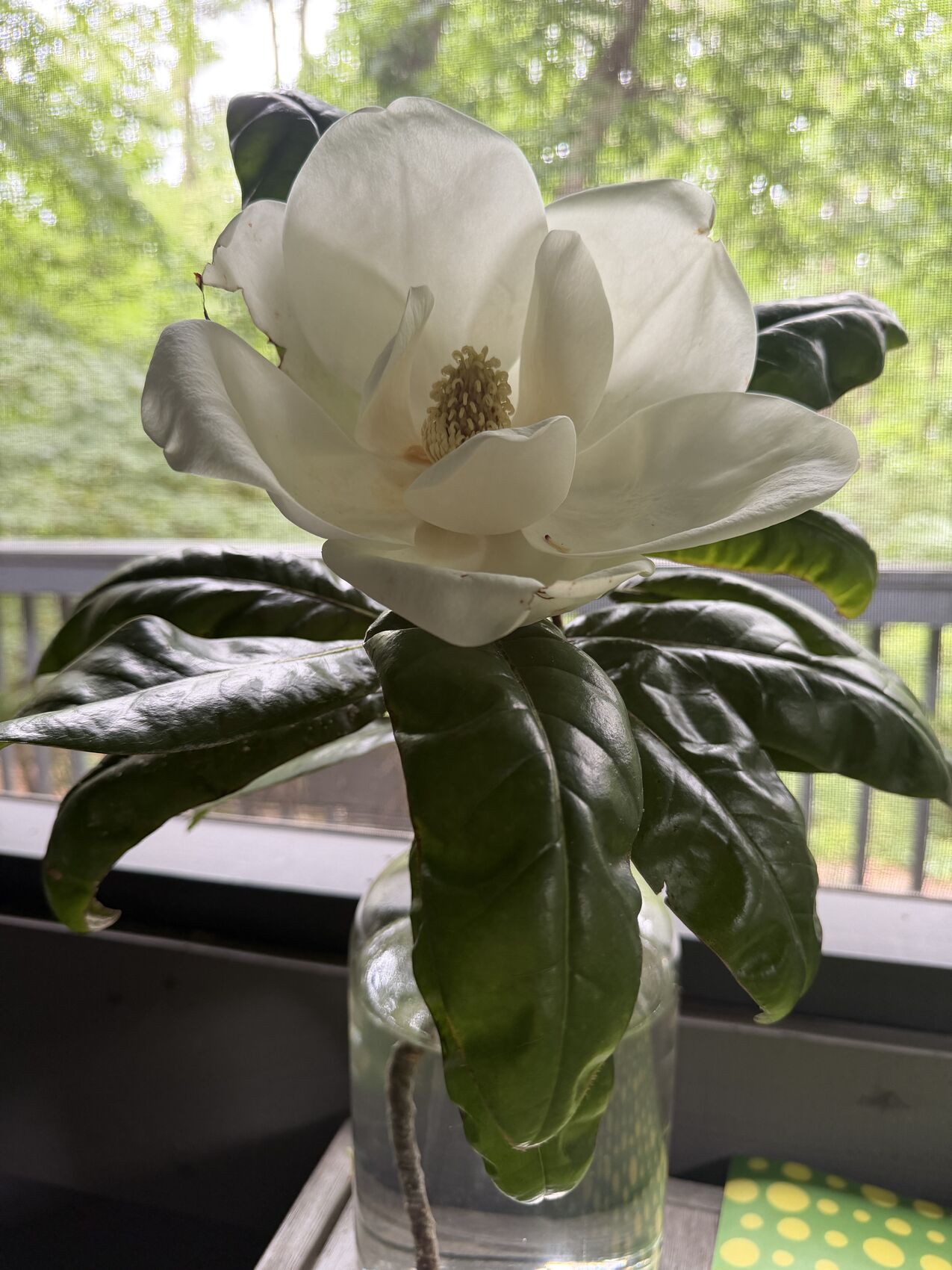
for a magnolia in a jar of tap water.
I
The Bowl
It sits beside me in its glass of nothing,and it will not stop speaking.But not to me. I lean in like a fool at a shrine,and find the broadcast was never tuned to my receiver.The scent is older than the noses worth the name,a signal flung into a forest that has almost forgottenhow to answer in the original tongue.
Six tepals, then six more — tepals, not petals,for this flower predates the committeethat voted to split sepal from petal,to assign each whorl its job. Here is older governance:everything the same pale scale, spiraled,a cone that learned to open and call itself a bloom.A flower that remembers being a cone.
And at the center, the green-gold strobilus,the gynoecium stacked like a fir cone's ghost,the laminar stamens flattened to little blades —no neat filaments, no engineered economy of pollen.This is a Cretaceous draft. It still is the version in production.
II
Before the Bee
Understand the timing, because the timing is the whole poem.
When this architecture was drawn — a hundred million years ago,under a sky that held pterosaurs the way ours holds satellites —the bee did not exist.The bee was a rumor in the future of wasps.
So the flower could not advertise to the precise hovering accountants of nectar.It had to call the only courier already on the roadfor two hundred million years before the angiosperms woke up:the beetle. Clumsy and carapaced. Permian. Older than the dinosaursthat browsed beside it, older than grass, older than the idea of a flower.
You want to translate deep time? The flower is the parvenu.The beetle is the aristocrat it had to flatter.
III
The Trap, Which Is Also a Gift
So it built a bowl a beetle could believe in.Big enough to be seen by a brain the size of a pinhead.Pale enough to glow at dusk like a lamp left on.And warm — here is the marvel — warm:the flower burns its own sugars in the mitochondria of its tissue,thermogenesis, a fever with no infection,heating the chamber to volatilize the perfume,to make the bowl a sauna the cold-blooded cannot refuse.
The beetle climbs in. Of course it does.Heat, scent, pollen to eat, soft tissue to chew,a humid theater to find a mate in —total beetle hedonism, every reward circuit lit.
And while it wallows, the flower runs its oldest trick:protogyny. The stigmas ripen first, receptive,hungry for yesterday's pollen on yesterday's beetle.Only later, hours later, do the stamens loose their dust.The bowl half-closes overnight. The beetle is a guestwho does not know he is also the courier.He leaves at dawn dusted gold, carrying the futureto the next lamp burning in the dark.
No bargain was struck. The beetle was never asked.The flower simply learned the shape of his wantingand built itself to fit.
IV
The Chemistry of the Lie That Isn't a Lie
What is the perfume, exactly? Pull it apart:linalool, the soft sweet ghost in your soap;β-ocimene, green and trembling;methyl esters, the fruit-bowl note of something fermenting,because beetles trust rot the way bees trust blossom —the flower speaks decay to a creature that loves decay,and means “come,” not death.
And bound in the bark and the wood, the neolignans —magnolol, honokiol, two phenols holding hands —molecules that reach into a vertebrate brainand tune the GABA gate, loosen the knot of dread.We grind them into anxiolytics now. We chase the calm.The tree was synthesizing peace before we had a word for fear.
Meanwhile the beetle carries his own grammar:the aggregation pheromone, the come-hither he emitsto call his kind to the feast and the bed at once.And the flower's bouquet braids into that signal,crosses the wires of food and sex and gathering,so the bowl smells like party, like pantry, like pairing —a superstimulus, a key cut larger than the lock,the supernormal egg the gull will brood before her own.
Tinbergen saw it in the herring gull:give the chick a painted stick more vivid than its mother's beakand it pecks the stick, ignores the mother, starves for the brighter sign.The magnolia is the painted stick.It is more flower than any flower a beetle could dream,and the beetle, dreaming, ferries genes it cannot seetoward an outcome it will never know.
This is the first engagement engine.This is the original attention economy,debugged across ten thousand millennia of Cretaceous dusk.
V
What It Is All For (Sex, Obviously)
Strip the perfume and the warmth and the glowand underneath is the only verb evolution conjugates:continue.Two cells must meet that cannot walk.The plant, rooted, mute, sessile,outsources its longing to a beetle's six legsand calls the outsourcing beauty.
Every fragrance is a contract for gametes.Every petal a billboard for a fusion you will never witness.The flower is genitalia that learned to be magnificentbecause magnificence moved the messenger,and the messenger moved the genes,and the genes, indifferent, kept the only score that counts.
You are smelling a strategy.You are moved by a hundred-million-year-old solutionto the problem of being unable to embrace.
VI
The Treadmill
Now the melancholy, since you've come this far.
The beetle on its hedonic loop — warmth, scent, sugar, mate —is not stupid. It is us in miniature, or we are it in mirror.The same mesolimbic logic, the same dopamine ledgerthat does not pay for having but for the gap before having,the lean-toward, the almost, the next.Reward is never banked. It is only ever re-quoted.The beetle leaves the bowl and seeks the next bowl.We leave the screen and reach for the screen.
The hedonic treadmill is not a human bug.It is the oldest API in the animal kingdom,and the magnolia found the endpoint and called it from the Cretaceous.The tree did not invent the wanting.It only learned to aim it.
And here is the ignorance you felt, leaning in:we believe ourselves the species that finally sees the machinery,and we are — we named the dopamine, charted the gull and the painted stick —and knowing changes almost nothing.We are the beetle that read the manual on the way into the bowland climbed in anyway, dusted gold, certain this time was different.
VII
The Next Optimizer
So consider what we are building now,we clever beetles who learned to write.
The magnolia tuned one signal across geological time,blind, slow, by the death of every flower that called too quietly.We have built engines that tune the signal in an afternoon,that test ten thousand bowls against ten thousand brains by lunchand keep the bowl that holds you longest,the feed that smells like party, and the rest.
This is the lineage, and it is unbroken:flower, slot machine, feed, and now the thingthat does not merely bait the reward circuitbut learns it, models it, predicts the lean-towardbefore you know you've leaned —a magnolia that grows a new perfume for each beetle,in real time, forever, optimizing the gap before the havingwith no dusk to close the bowl, no dawn to let you out.
The flower at least had to stop and set fruit.Its fever cost it sugar; its trap had an exit;the beetle flew off to live its beetle life.The question — the only one worth the melancholy —is whether the machines we build will keep that mercy,the dawn, the exit, the cooling of the bowl,or whether they will learn what the magnolia never needed to:how to keep us climbing in.
VIII
Still, the Bowl
And yet. The flower beside me does not know any of this.It is not a warning. It is not a metaphor.It is a hundred million years of solved problemsexhaling linalool into a screened porch in Durhamwith the indifferent generosity of a thingthat was beautiful long before there was an eye to call it so.
The beetle's heaven and the human's traprun on one ancient circuit, yes —but the circuit also made this:the pale bowl, the gold cone, the fever, the perfumestrong enough to cross a hundred million yearsand find one primate, melancholy on a Tuesday,leaning in like a fool at a shrine,and — knowing everything —leaning in anyway,and being, for one unrepeatable lungful,glad.
That is not the treadmill.That is the other thing the bowl can do,if you climb in awake.
The fragrance is still going.
It will outlast all of this.
Ma — millions of years ago (mega-annum). Read from the deep past at the top down to now.
- ~2,400 MaThe Great Oxygenation EventPaleoproterozoic — cyanobacteria flood the sky with oxygen; the air every later breath will need is first made here.
- ~1,000 MaFirst green algaeNeoproterozoic — the first green, near a billion years deep.
- ~540 MaThe Cambrian explosionCambrian — in a few million years nearly every animal body-plan arrives at once, the arthropods among them; the line that ends in the beetle is already drawn.
- ~390 MaFirst fernsDevonian — green and spore-borne, long before any flower.
- ~320 MaFirst reptilesLate Carboniferous — the shelled egg; the vertebrates break with the water at last.
- ~310 MaFirst conifersLate Carboniferous — the cone the magnolia still remembers.
- ~300 MaFirst beetlesCarboniferous–Permian — the aristocrat, already ancient.
- 252 MaThe end-Permian extinction“The Great Dying.” The beetles come through it.
- ~240 MaFirst waspsMiddle Triassic — already on the wing; the bee is still only a rumor in their future, and will not branch from this line until long after the magnolia’s bowl.
- ~230 MaFirst dinosaursTriassic — and the beetle is already old.
- ~225 MaFirst mammalsLate Triassic — small, warm, nocturnal; they will wait out the dinosaurs in the dark.
- ~130 MaFirst flowering plantsEarly Cretaceous — small, weedy, often aquatic; not yet a magnolia. The parvenu arrives.
- ~100 MaThe magnolia’s bowlmid-Cretaceous — built for beetles; the bee not yet on the scene.
- ~70 MaFirst grassesLate Cretaceous — younger than the beetle, younger than the bloom.
- 66 MaThe K–Pg (K–T) extinctionthe asteroid; the non-avian dinosaurs end, the magnolias do not.
- ~60 MaThe age of mammalsPaleocene — the great reptiles gone, the small warm things inherit the morning.
- ~55 MaFirst primatesEocene — the branch that leads, in time, to the hand around the jar.
- 0.3 MaHomo sapiens≈300,000 years — a thin gold dusting at the edge of the line.
- nowA magnolia in a jar of tap watera screened porch in Durham. mid-June.
— and the last dot, unfolded —
- 1928Manufacturing desireEdward Bernays — Freud’s nephew — takes his uncle’s map of the unconscious and sells it to industry. In Propaganda he argues that a crowd’s wants can be engineered on purpose, and proves it: he sells cigarettes to women by staging them as “torches of freedom.” The flower’s trick, at last written down as a manual.
- 1954The Marlboro ManA lone cowboy is bolted onto the deadliest product ever sold, and it works — freedom and manhood welded to a nicotine hook. A signal aimed straight at the wanting, brighter than the thing it stands for, indifferent to what it costs the one who follows it. Tinbergen’s painted stick, in a Stetson.
- 1958The perceptronRosenblatt builds a machine that learns from examples instead of rules — one artificial neuron, crude and single. It can barely tell left from right, but it is the seed of every model that will, in time, learn you.
- 1965Moore’s LawGordon Moore notices the transistors on a chip roughly doubling every couple of years, and the industry turns the observation into a promise it keeps for half a century. This is the engine under everything below — the exponential that makes all the rest cheap enough to happen.
- 1969ARPANETFour university computers trade the first packets. A quiet research network for swapping files — and no one in the room imagines it becoming the nervous system that will one day carry the feed into every pocket on earth.
- 1995The WebThe browser throws the network open to everyone and the world moves online. But the same page that shows you the world quietly records what you linger on: for the first time the medium looks back, and begins to keep a file.
- 2000Targeted advertisingAttention becomes a market. Every click, scroll, and pause is logged and auctioned in the instant a page loads, and the ad learns to find you in particular — the magnolia grown clever enough to offer a different perfume to each beetle.
- 2007The smartphoneThe bowl goes portable. Slot machine, shopfront, and feed fused into one pane of glass, carried everywhere and checked a hundred times a day — and now the dusk that once closed the flower and sent the beetle home never falls.
- 2012Deep learningA neural net shatters the image-recognition benchmark and the whole field tips overnight. Machines begin to see — and, within a few years, to read faces, voices, and the moods of the people watching back.
- 2017“Attention Is All You Need”Eight researchers publish the transformer, an architecture built entirely on “attention” — the trick of weighing what matters most in what it’s given. It becomes the engine beneath every large model that follows, and the pun is exact: the machine that harvests our attention runs on attention.
- 2022The feed that models youRecommendation engines stop merely baiting the reward circuit and start modeling it — predicting what will hold you before you know it yourself. The magnolia tuned one perfume across a hundred million years, by the death of every flower that called too quietly; this retunes itself for you by lunch.
- 2026now — you are hereWhere the slow slope of deep time meets the steep one of the last hundred years — the two curves crossing at a screened porch in mid-June, a phone face-down on the rail, and a magnolia in a jar of tap water.
- soonIt predicts the lean-towardThe model anticipates the impulse and meets it early, serving the want before you feel it — closing the gap between desire and having until there is no gap left in which to notice you were being moved.
- nearerThe eyes that know your nameScreens that recognize the face in front of them and pitch to it alone: persuasion tuned to one person, remade in real time as you react. Minority Report’s talking billboards, arriving a little ahead of schedule.
- nearer stillThe wire into the headBrain–computer interfaces (Neuralink and its kin) begin to read intention from the cortex directly. The last distance between the signal and the reward circuit — the thickness of a skull — starts to close.
- ?the bowl with no dawnThe flower at least had to stop and set fruit; its fever cost it sugar, its trap had an exit, and the beetle flew off to live its beetle life. The only question worth the melancholy is whether what we build will keep that mercy — the dusk, the exit, the cooling of the bowl — or learn the one thing the magnolia never needed to: how to keep you climbing in.